
Eight Times that Crowds Witnessed Death while being Entertained
As safety regulations within theaters improved, the amount of accidental deaths have dipped substantially in the last century. Unfortunately, there is always the risk of witnessing a performer pass away on stage. Whether it’s heart conditions, heat, or insane fans, the risk will always be there.
In the 1800’s news was slow to travel around the country and internationally. In some cases facts were misreported or stories were missed all together. Here are eight times that tragic incidents happened in front of a crowd and made headlines around the world.
1817 – The Last Act

Entry number one was the first known instance of an actor dying on stage since 1673. Not much is known about Mr. Cummins, not even his first name. He was playing the role of ‘Dumont’ in a production of ‘The Tragedy of Jane Shore’ written by Nicholas Rowe. On the evening of June 20th, as he uttered the final words of the play to a packed Leeds Theater, “May such befall me at my latest hour…” he died of ‘ossification of the heart’.
1829 – Over the Falls
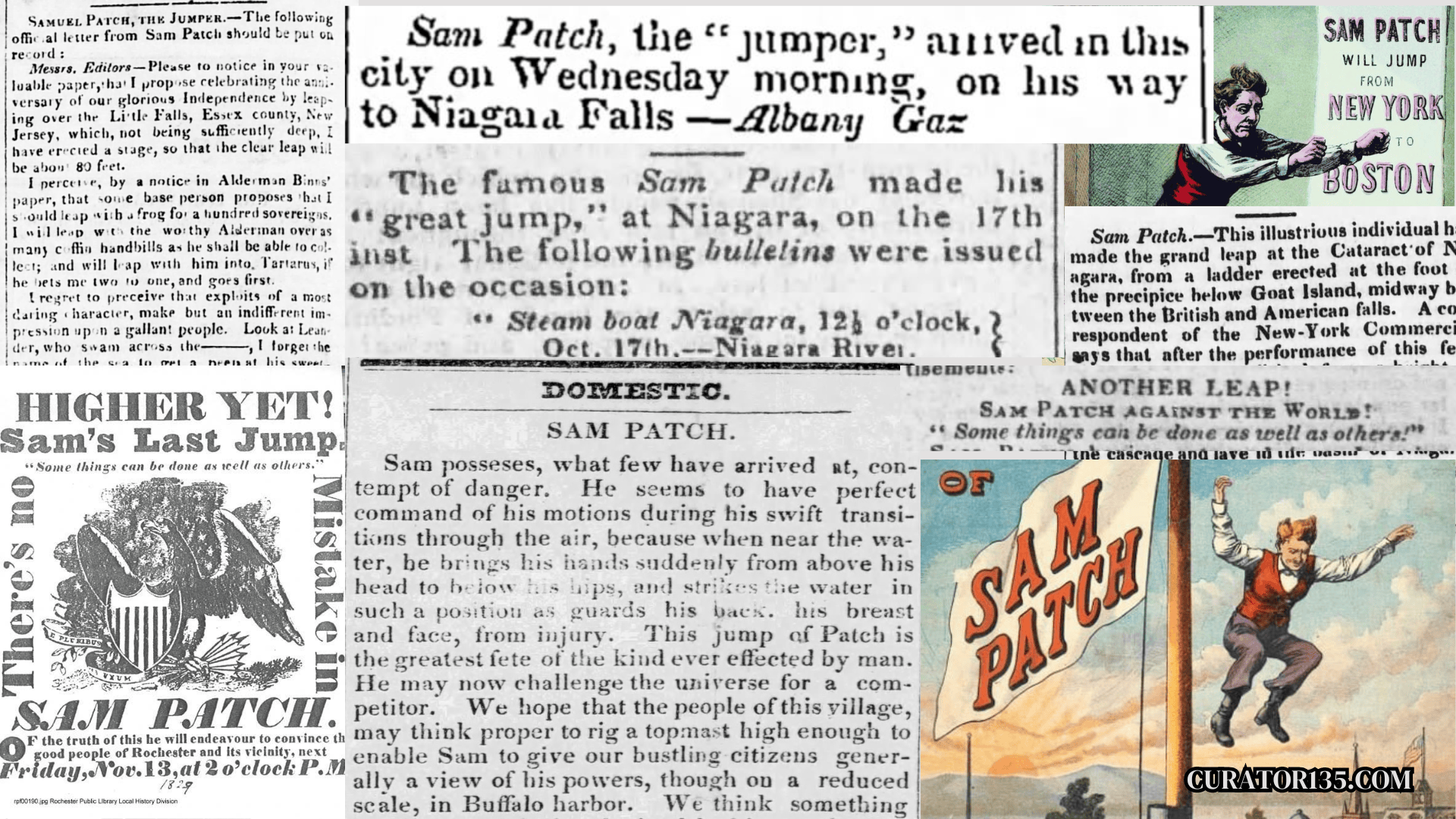


1829 was a big year for Sam Patch. Nearly 200 years before ‘going viral’ was as easy as hitting the record button on your phone, you had to work hard to make yourself known. In order to advertise his jumps, Sam would write a letter to the local newspapers before one of his over-the-falls stunts.
The month previous, Sam had performed a jump at Niagara Falls, now he was in Rochester, New York to tackle the Great Falls that sat high above the Genesee River. A jump on November 6th proved successful but not financially. After raising a disappointing amount of money, he decided to contact the press again and repeat the stunt one week later on November 13th.
After constructing a 25-foot stand, increasing the height of the jump to 125 feet, 8000 people watched and waited as he slowly worked his way towards the edge. Reports differ, but the general consensus is that at some point during the fall Patch lost consciousness. His body loosened from his normal entry formation and smacked into the surface of the water. He never resurfaced until the following spring when he was found by a local hunter, frozen in the river. Some people pinned Patch’s death on the crowd for urging him to jump before he was ready.
1844 – Just a Spark


Miss Clara Webster was a young, up and coming, dancer in 1844 and one of the stars listed in advertisements for the “Revolt of the Harem” show in London.
On December 14th, during the second act, Webster was performing her role of Zuliea, a royal slave, when she got too close to the gas line under the stage. The fabric of her dress caught fire and engulfed the young woman quickly. The audience, which included her mother, watched in horror as the young woman rushed around on stage, screaming for help. Another dancer pushed her away, fearing for her own dress, and Webster eventually ran towards a stagehand who pushed her to the ground and rolled around on top of her. The stagehand suffered burns of his own during his heroic act but not like Clara Webster.
The dancer was quickly taken to a doctor’s home who treated her as best he could. Eventually, Clara was sent to her own home to recover. Newspapers wrote that she would be okay, but a few days later she succumbed to her injuries.
1861 – Sisters


The Gale Sisters were a quartet of young, beautiful, ballerinas from England. Hannah (20), Abeona (18), Zela (16) and Ruth (15) were part of a large ballet troupe that was engaged in a nationwide tour of the United States.
On the evening of September 14th the tour had reached Philadelphia. More than 1,500 filled The Continental Theater on Walnut Street to see a performance of “The Tempest.”
During the performance, Zela was reaching for a costume backstage and came into contact with a gas jet which ignited her clothing. The three sisters, along with numerous other dancers attempted to extinguish the flames but as they got close, the fire quickly spread to the other dancers. In the crowd, the audience heard the commotion and saw flashes of light as well as stagehands scrambling around. Eventually, one of the dancers ran downstairs toward the stage while engulfed in flames.
The stage manager came out and asked the audience to please calmly exit the theater. At this point, at least a dozen girls were trapped in the dressing room just up the steps from the stage below. Several girls, including one of the Hale sisters jumped from the second story window to the street below.
When all was said and done, nine girls died from their injuries, including all four of the Hale sisters. They are buried together at the Mount Moriah Historic Cemetery in Philadelphia.


1872 – One Armed Lion Tamer

Lion tamer Thomas Macarte was professionally known as “Massarti the Lion Tamer”. Some time before 1872 he had a run in with a lion that took one of his arms. He stuck with his profession and continued to tour with a traveling circus show. On January 3rd of 1872 he entered the lion’s cage for a performance at Bolton market. He wasn’t inside the cage long before all five lions attacked him. Macarte tried to fight them off with his sword and a pistol full of blanks but they easily overcame the one armed man. Crew members eventually forced the animals back into an inner cage but they dragged Macarte with them.
He was eventually rescued but died on the way to the hospital.
1882 – Accidental Discharge

Anna Von Behren joined Frank Frayne’s Western Tour in September of 1882. On Thanksgiving Day, the tour stopped at the Coliseum in Cincinnati. During the fourth act of the matinee performance Von Behren was blindfolded and an apple was placed upon her head. Frayne pointed a .22 caliber parlor rifle at her and it accidentally went off. The bullet entered her skull just above the eye and she died within fifteen minutes.
The crowd wasn’t sure what they had just witnessed until the curtain fell, the play stopped, and witnesses saw Frayne being arrested.
In court, Frayne stated that “the thread of the screw which held the spring catch was worn or torn off, and that sent the bullet below its aim.” Frayne himself had been injured during the faulty shot, his chest and neck were burned black by the powder emitted. Frayne was eventually discharged from the court and the case was dropped. Newspapers reported that Frayne and Von Behren were engaged to be married.
1888 – Hellish Heart Attack

Frederick Federici was a world-renowned Italian-born British opera singer known for his work in the bass-baritone roles of the Savoy Operas. On March 3rd of 1888 Federici was performing the role of Mephistopheles in ‘Faust’ on opening night at the Princess Theatre in Melbourne, Australia.
At the end of the opera the character of Mephistopheles sinks down dramatically through a trapdoor. As Federici was being lowered down into the basement, the 37-year-old star suffered a heart attack. He was carried to the theatre’s green room, where his doctor was unable to revive him and pronounced him dead minutes later.
The incident became mysterious due to the fact that neither the cast nor the audience were aware of his death since multiple people reported seeing him on stage taking bows with the rest of the performers. Since then, members of the theatre’s staff have claimed to see a ghostly figure in evening dress at the theatre.
1897 – A Standing Ovation

Armand Castelmary was another celebrated Operatic bass performer. In 1897, while performing onstage at the Metropolitan Opera in New York City, Armand sang for the final time. As he was finishing up his performance of Friedrich von Flotow’s “Martha” he collapsed. The audience responded to what they thought was brilliant acting by giving him a long, loud ovation as the curtain was lowered.
Castelmary died from a heart attack at the age of 63.


Leave a Reply